Ultrasound fixes the accuracy problem. It also costs too much.
Cervicam Thesis Series
Part 2 of 6
- 1 The most important number in childbirth is basically a guess
- 2 Ultrasound fixes the accuracy problem. It also costs too much.
- 3 Building a cervix-measuring camera probe on a Raspberry Pi budget
- 4 Everything that broke while building Cervicam
- 5 I tested Cervicam with real healthcare workers. Here’s the usability score.
- 6 What a proof-of-concept device can and can’t tell you
Last time, I told you that the number clinicians rely on most during labor (how many centimeters dilated you are) is measured by feel, with two fingers, and that the research says it’s wrong a lot of the time. So why hasn’t anyone just… fixed that?
Turns out someone has. It’s called ultrasound, and the research on it is genuinely good. The problem is everything around the research.
The research actually likes ultrasound
Out of every device category researchers have tried for measuring cervical dilatation (mechanical, electromechanical, electromagnetic), ultrasound consistently comes out on top. It’s accurate, it’s not bulky, and unlike a single finger check, it can keep evaluating the cervix continuously instead of just taking one snapshot in time.1 Other studies echo the same thing.2 And on top of being more accurate, it’s also better tolerated by the person actually in labor than having someone’s fingers inside you.3
So the literature isn’t divided on this. Ultrasound beats the two-finger guess on basically every axis that matters. If this were just a question of “which method works better,” the answer would already be settled.
The catch: it doesn’t scale to where it’s needed most
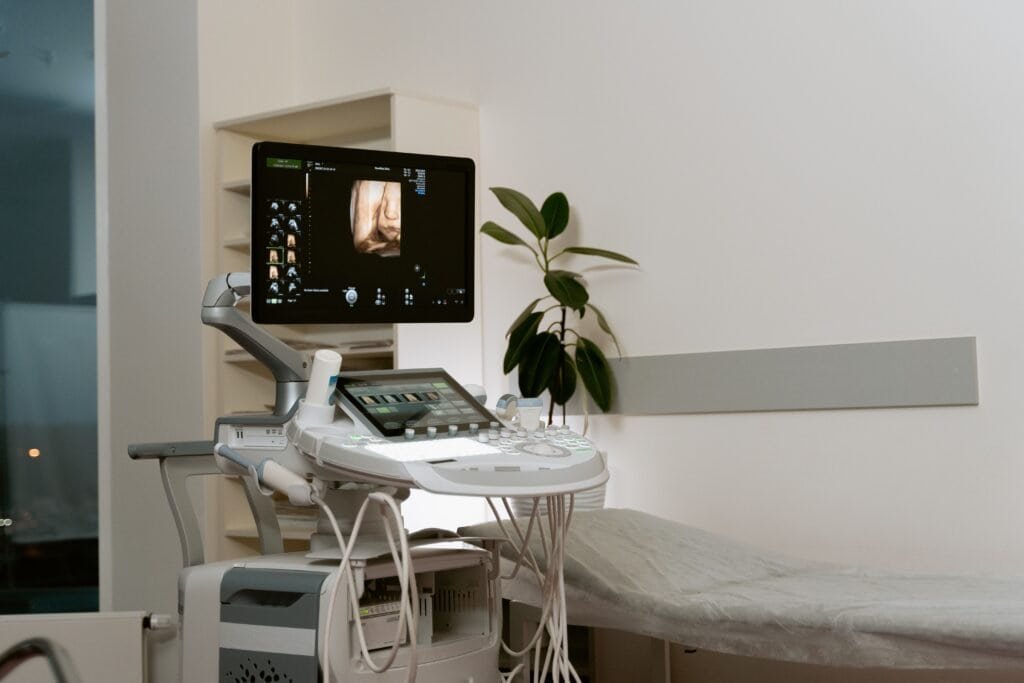
Here’s where it falls apart. A full, cart-based obstetric ultrasound machine (the kind a hospital radiology department actually owns) costs somewhere between £30,000 and £100,000 (roughly $40,000 to $134,000 USD, at current exchange rates). A “standard” dedicated point-of-care ultrasound device, something smaller and more purpose-built, still runs £6,000 to £19,500 (roughly $8,000 to $26,000 USD).5
Even the cheap end of this market isn’t actually cheap. Butterfly, the company that makes a handheld ultrasound probe that plugs into a phone, prices its current device at around $4,000 USD. Its first-generation device, back in 2018, cost $2,000.6 The UK’s own health technology watchdog lists that same device at £1,699 per unit plus £360 a year in membership fees (about $2,275 plus roughly $480 a year, converted).5
That’s not a rounding error compared to two fingers and some lubricant. And the money isn’t even the whole problem. Operating any of these devices well requires real training, which means a hospital can’t just buy one and hand it to whoever’s on shift. That compounds a staffing shortage severe enough that one industry outlet has called it the single biggest hurdle to the Philippines actually delivering on Universal Health Care.7
Butterfly’s own founder, Jonathan Rothberg, frames the gap he’s trying to close in stark terms:
“Two-thirds of the world’s population has no access to imaging.”6
That’s his company’s pitch, not an independently audited statistic, so take it as the sales case it is, but it’s not hard to believe. Butterfly says it’s shipped over 150,000 of its devices worldwide, including 500 to health centers in Kenya and units carried by medics in Ukraine.6 Good. None of that changes the sticker price for a hospital working with a fraction of that budget.
Someone already tried to build something cheaper
This isn’t a hypothetical gap in the market. In 2021, a team ran a randomized controlled trial on a device called DilaCheck, a measuring string with two soft plastic rings worn over a clinician’s gloved fingertips, built specifically to be a low-cost, low-tech alternative to both the finger exam and full ultrasound.4
Before the real trial, they ran a simulator test first: 50 labor and delivery providers each did 8 exams the normal way and 8 with DilaCheck, on a cervix simulator built out of PVC pipe. The results looked great. Providers went from 46.3% correct exams with the traditional method up to 96.3% with DilaCheck. That’s a 108% jump in accuracy, and it didn’t seem to matter how experienced the provider was.4
Then they ran the actual trial, on actual patients, and the results flipped. Examiners using DilaCheck only agreed with each other 19% of the time, compared to 42.9% for the plain manual exam. The device that looked so promising on a plastic pipe didn’t just fail to improve on the status quo in real labor and delivery rooms: it made agreement between examiners worse.4
So the one serious, documented attempt at a cheap fix for this exact problem didn’t work. Ultrasound works but doesn’t scale. That’s the space I built Cervicam into, not because I think it’s the fix, but because I wanted to actually build something and see what that surfaces. Next post: what’s actually inside it.
One thing I want to be upfront about before you read on: this is a proof-of-concept, tested only on a 3D-printed cervix model, never a real patient. Even several iterations further, the idea of this being used on someone in labor is a scary proposition.
This post is adapted from my unpublished Master’s thesis, “Touch Me Not”: A Cervix Uteri’s Plea for a More Objective Cervical Dilatation Measurement — Proof of Concept for a Camera-Based Cervimeter, completed July 2024 for my MSIT at MSU-IIT. Publishing it wasn’t a requirement for the degree, so parts of it are appearing publicly here for the first time. It hasn’t been peer-reviewed, and the views and conclusions are my own. Shared under CC BY-NC, with attribution appreciated.
References
Most of these come straight from my thesis’s own reference list; two are new, found while fact-checking the actual cost figures (the thesis itself never puts a number on “ultrasound is expensive,” it just says so). One more (#7) is a citation the thesis already had for a claim this post was making without one.
1 Brancadoro, M., Tognarelli, S., Fambrini, F., Ragusa, A., & Menciassi, A. (2018). Devices for measuring cervical dilation during labor. Obstetrical & Gynecological Survey, 73(4), 231–241. https://doi.org/10.1097/OGX.0000000000000548
2 Hassan, W. A., Taylor, S., & Lees, C. (2021). Intrapartum ultrasound for assessment of cervical dilatation. American Journal of Obstetrics & Gynecology MFM, 100448. https://doi.org/10.1016/j.ajogmf.2021.100448
3 Usman, S., Barton, H., Wilhelm-Benartzi, C., & Lees, C. C. (2019). Ultrasound is better tolerated than vaginal examination in and before labour. Australian and New Zealand Journal of Obstetrics and Gynaecology, 59(3), 362–366. https://doi.org/10.1111/ajo.12864
4 Martin, E. L., Firman, B., & Berghella, V. (2021). Novel device vs manual examinations for the measurement of cervical dilation in labor: A randomized controlled trial. American Journal of Obstetrics & Gynecology MFM, 3(3), 100328. https://doi.org/10.1016/j.ajogmf.2021.100328
5 Butterfly iQ+ for diagnostic ultrasound imaging. (2021, March 4). National Institute for Health and Care Excellence (NICE), Medtech innovation briefing MIB254. https://www.nice.org.uk/advice/mib254/chapter/Summary
6 Reuter, E. (2026, April 27). With ultrasound on a chip, Butterfly Network aims for global reach. MedTech Dive. https://www.medtechdive.com/news/with-ultrasound-on-a-chip-butterfly-network-aims-for-global-reach/818119/
7 Cortez, G. M. (2020). Public-hospital staffing could be Universal Health Care’s biggest hurdle. BusinessWorld Online. https://www.bworldonline.com/public-hospital-staffing-could-be-universal-health-cares-biggest-hurdle/
Enjoyed this one?
Let J know with some claps