The most important number in childbirth is basically a guess
If you’ve never been in a delivery room, here’s a fact that might surprise you: the number the whole medical team watches most closely during labor, the one that decides whether things are “progressing normally” or whether it’s time to intervene, is measured by a clinician inserting two fingers and guessing how many centimeters apart they feel.
That’s it. No instrument, no sensor, no digital readout. Just touch.
It’s called cervical dilatation, it’s described on a scale of 0 (closed) to 10 (fully dilated, baby’s on its way), and it’s been measured this way, by feel, since long before anyone thought to question it.
The number that runs the whole room
Every hospital birth gets tracked against a tool called the partograph: a chart, recommended by the WHO, that plots cervical dilatation against time.1 If the line stays to the left of a threshold called the “alert line,” labor is progressing normally.2 If it crosses it, that’s the signal for intervention3; things like rupturing the membranes or giving a drug to speed contractions along.
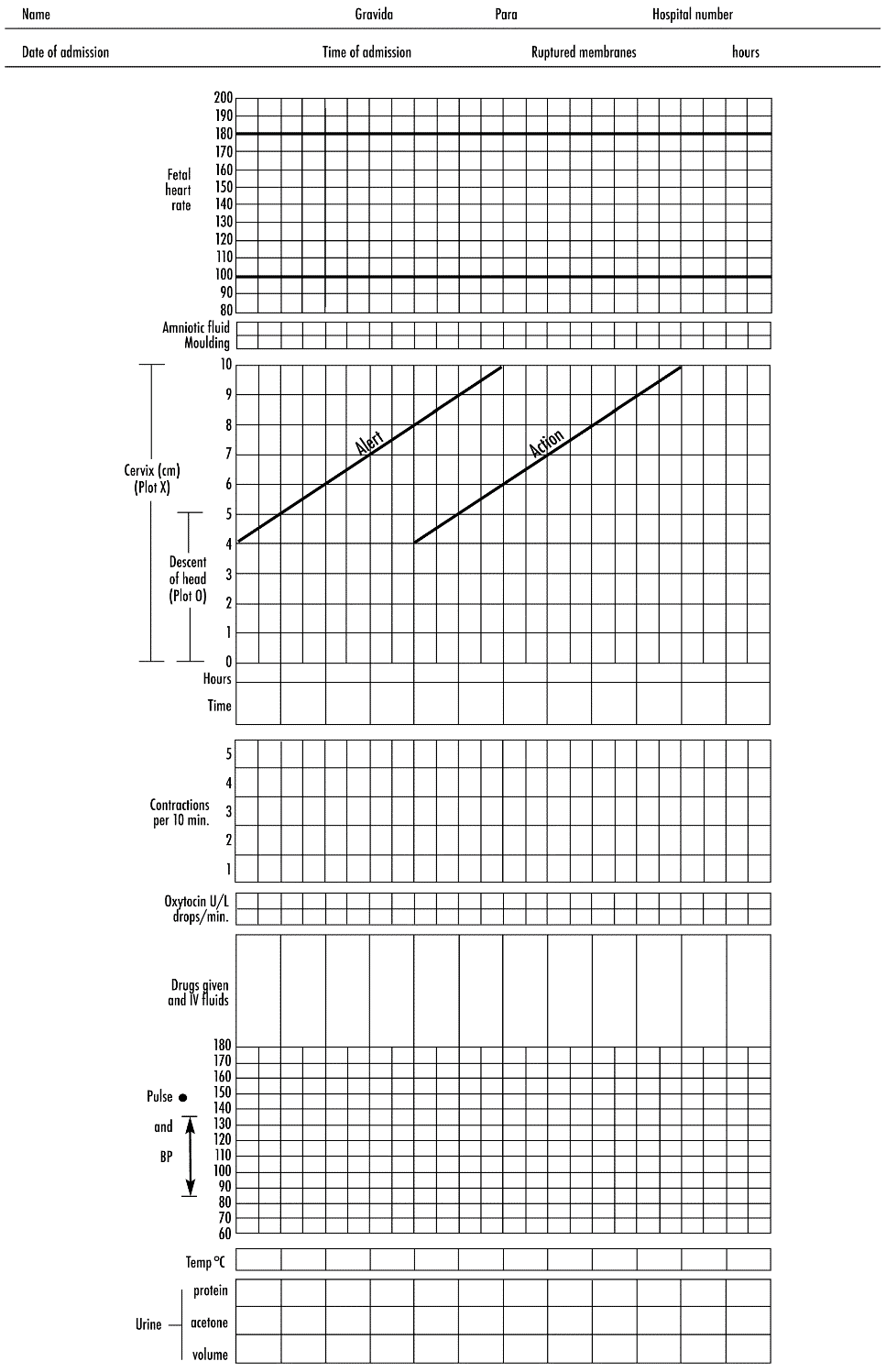
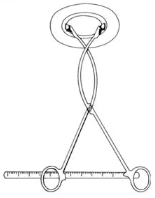
The partograph’s ancestor is the “Friedman Curve,” named after Emanuel Friedman, who plotted it in 1954 and also tried, two years later, to build an actual device to measure dilatation (a forceps-like clip attached to the cervix).4 It worked, technically. It also injured the cervix, which turned out to be a dealbreaker, and the idea was shelved. Vaginal exams by hand have been the standard ever since.
The part where it falls apart
Here’s the problem: when researchers have tested how accurate “measuring by feel” actually is, the results aren’t close to good. A 1989 Lancet study had midwives and obstetricians assess simulated cervixes, and found they got it right roughly half the time.5 A later study with over a hundred examiners and more than 1,500 simulated measurements found similar numbers.6 Another study comparing clinicians against each other, rather than against a known answer, found they only agreed with one another on about half of all measurements.7
Half. Not “slightly off.” Half.
And this isn’t some fringe critique: it’s part of why, in 2002, a researcher named Zhang re-examined Friedman’s original data and found that “normal” labor doesn’t actually look like Friedman’s curve at all.8 Active labor, Zhang argued, doesn’t reliably start until 6cm, not Friedman’s 4cm, meaning a huge number of labors that were once flagged as dangerously “slow” under the old curve were just… normal. ACOG adopted the 6cm standard in 2014,9 pushed it further in a 2024 update,10 and the debate over exactly where to draw these lines is still, genuinely, ongoing today, seventy years after Friedman first drew his.
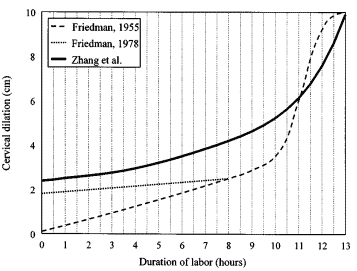
That’s not a small footnote. A “slow progressing labor” diagnosis isn’t just a note in a chart: it can lead straight to interventions like artificial rupture of membranes, labor-inducing drugs, or a C-section.11 In the Philippines, PhilHealth currently covers a Caesarean delivery at about ₱58,000 (roughly $940 USD) versus roughly ₱29,000 ($470 USD) for a normal one — exactly double.12 A measurement that’s wrong half the time isn’t just an academic inconvenience. It has downstream consequences for a woman’s body, her recovery, and her bill.
Nobody asked if it hurts
There’s a second problem that gets less attention: a vaginal exam is not a comfortable thing to have done to you, repeatedly, while in labor.
Across several studies surveying women after childbirth, the numbers are consistent and not subtle: over 80% reported pain during vaginal exams, more than two-thirds reported general discomfort, and a lot of women reported the exams happening more often than guidelines recommend, performed by more different people than they expected, sometimes without much explanation of why.13,14,15,16 The WHO’s own guidance recommends exams at most every four hours for low-risk labors.1 In practice, that interval isn’t always followed.
There’s actual biology behind why this hurts more than people assume, too: a study examining nerve changes in the cervix during pregnancy found it may be one of the primary sources of labor pain itself, not just an incidental discomfort.17
In a Cochrane review comparing the effectiveness, acceptability, and consequences of vaginal exams against other approaches, the lead author’s own conclusion:18
A “widespread use of this intervention without good evidence of effectiveness” — and that’s despite how sensitive the procedure is for the women receiving it, and its potential for real harm in some settings.
A 2022 update to that same review found largely the same thing: not enough high-certainty evidence to say the practice, done the way it’s usually done, actually improves outcomes.19
So why does everyone still do it this way?
Because nobody’s built a better option that’s actually practical. Ultrasound measures the cervix more objectively, but it’s expensive, it takes real training to operate, and in places where maternal health outcomes are worst, it’s often simply not available. (More on that in the next post.)
So the gold standard stays “two fingers and a guess,” not because it’s good, but because nothing better has made it to the delivery room yet.
That gap, half-accurate measurements that still run the whole decision tree, is the actual starting point for the device I spent my thesis building. It’s not a solved problem. It’s barely an attempted one. But it’s where this series starts.
This post is adapted from my unpublished Master’s thesis, “Touch Me Not”: A Cervix Uteri’s Plea for a More Objective Cervical Dilatation Measurement — Proof of Concept for a Camera-Based Cervimeter, completed July 2024 for my MSIT at MSU-IIT. Publishing it wasn’t a requirement for the degree, so this is its first public appearance — it hasn’t been peer-reviewed, and the views and conclusions are my own. Shared under CC BY-NC — credit me, don’t sell it.
References
Most of these come straight from my thesis’s own reference list. A few are new, added while fact-checking this post — either published after I finished the thesis, or correcting a figure that had gone stale since 2024.
1 World Health Organization. (2018). WHO recommendations: Intrapartum care for a positive childbirth experience. http://www.ncbi.nlm.nih.gov/books/NBK513809/
2 Philpott, R. H., & Castle, W. M. (1972). Cervicographs in the management of labour in primigravidae. I. The alert line for detecting abnormal labour. The Journal of Obstetrics and Gynaecology of the British Commonwealth, 79(7), 592–598. https://doi.org/10.1111/J.1471-0528.1972.TB14207.X
3 Philpott, R. H., & Castle, W. M. (1972). Cervicographs in the management of labour in primigravidae. II. The action line and treatment of abnormal labour. The Journal of Obstetrics and Gynaecology of the British Commonwealth, 79(7), 599–602. https://doi.org/10.1111/J.1471-0528.1972.TB14208.X
4 Friedman, E. A. (1956). Cervimetry: An objective method for the study of cervical dilatation in labor. American Journal of Obstetrics & Gynecology, 71(6), 1189–1193. https://doi.org/10.1016/0002-9378(56)90424-0
5 Tuffnell, D. J., Johnson, N., Bryce, F., & Lilford, R. J. (1989). Simulation of cervical changes in labour: Reproducibility of expert assessment. The Lancet, 334(8671), 1089–1090. https://doi.org/10.1016/S0140-6736(89)91094-5
6 Phelps, J. Y., Higby, K., Smyth, M. H., Ward, J. A., Arredondo, F., & Mayer, A. R. (1995). Accuracy and intraobserver variability of simulated cervical dilatation measurements. American Journal of Obstetrics and Gynecology, 173(3 Pt 1), 942–945. https://doi.org/10.1016/0002-9378(95)90371-2
7 Buchmann, E., & Libhaber, E. (2007). Accuracy of cervical assessment in the active phase of labour. BJOG: An International Journal of Obstetrics & Gynaecology, 114(7), 833–837. https://doi.org/10.1111/j.1471-0528.2007.01386.x
8 Zhang, J., Troendle, J. F., & Yancey, M. K. (2002). Reassessing the labor curve in nulliparous women. American Journal of Obstetrics and Gynecology, 187(4), 824–828. https://doi.org/10.1067/mob.2002.127142
9 Kreisman, R. (2016, June 21). American College of Obstetrics and Gynecology (ACOG) replaces Friedman’s curve. Chicago Birth Injury Lawyers Blog. https://www.robertkreisman.com/birth-injury-lawyer/american-college-obstetrics-gynecology-acog-replaces-friedmans-curve/
10 Cahill, A. G., Raghuraman, N., Gandhi, M., & Kaimal, A. J. (2024). First and second stage labor management: ACOG Clinical Practice Guideline No. 8. Obstetrics & Gynecology, 143(1), 144–162. https://doi.org/10.1097/AOG.0000000000005447
11 Boyle, A., Reddy, U. M., Landy, H. J., Huang, C. C., Driggers, R. W., & Laughon, S. K. (2013). Primary cesarean delivery in the United States. Obstetrics and Gynecology, 122(1), 33–40. https://doi.org/10.1097/AOG.0B013E3182952242
12 Philippine Health Insurance Corporation. (2026). Rationalization of case rates for select maternal and gynecologic services in the hospital setting (PhilHealth Circular No. 2026-0005). https://www.philhealth.gov.ph/circulars/2026/TS-PC-2026-0005-English.pdf
13 Hassan, S. J., Sundby, J., Husseini, A., & Bjertness, E. (2012). The paradox of vaginal examination practice during normal childbirth: Palestinian women’s feelings, opinions, knowledge and experiences. Reproductive Health, 9(1), 16. https://doi.org/10.1186/1742-4755-9-16
14 Hatamleh, R., Gharibeh, H., & Al Bnayan, A. (2012). Jordanian women’s perceptions of intrapartum vaginal examination. Evidence Based Midwifery, 10(4), 131–136.
15 Lewin, D., Fearon, B., Hemmings, V., & Johnson, G. (2005). Women’s experiences of vaginal examinations in labour. Midwifery, 21(3), 267–277. https://doi.org/10.1016/j.midw.2004.10.003
16 Ying Lai, C., & Levy, V. (2002). Hong Kong Chinese women’s experiences of vaginal examinations in labour. Midwifery, 18(4), 296–303.
17 Tingåker, B. K., Ekman-Ordeberg, G., Facer, P., Irestedt, L., & Anand, P. (2008). Influence of pregnancy and labor on the occurrence of nerve fibers expressing the capsaicin receptor TRPV1 in human corpus and cervix uteri. Reproductive Biology and Endocrinology, 6, 8. https://doi.org/10.1186/1477-7827-6-8
18 Downe, S., Gyte, G. M., Dahlen, H. G., & Singata, M. (2013). Routine vaginal examinations for assessing progress of labour to improve outcomes for women and babies at term. Cochrane Database of Systematic Reviews, 7, CD010088. https://doi.org/10.1002/14651858.CD010088.pub2
19 Moncrieff, G., Gyte, G. M. L., Dahlen, H. G., Thomson, G., Singata-Madliki, M., Clegg, A., & Downe, S. (2022). Routine vaginal examinations compared to other methods for assessing progress of labour to improve outcomes for women and babies at term. Cochrane Database of Systematic Reviews, 2022(3), CD010088. https://doi.org/10.1002/14651858.CD010088.pub3